David Straker
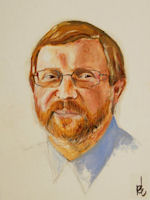
(painting by Heledd Straker)
.
I grew up literally in my parents' business. We lived over the shop which my
mother ran, and next to my father's printing works, where he printed the local newspaper. Although the days of hot metal are long gone, I
still remember climbing amongst the machinery (when it was turned off!) and
wondering how it all worked. My father was amazingly tolerant of my endless
bashing bits of metal and wood into models.
In my early teens, I turned on to electronic engineering and eventually did my first
degree in the subject. From this, I defined myself as an engineer: a person who
understands how things work; a person who can fix and improve things; a person
who balances a deep theoretical understanding with practical action.
Electronics as a career wasn't to last that long. After a year, my fiancée
(later my wife) decided to go back to University to study teaching, and I went
with her (long story). I enjoyed teaching, and it brought out a second layer of
how I still define myself: someone who loves to help other people understand and
succeed. The pay and prospects were dismal, however, so I skipped back to
engineering, this time in software. Whilst having fun as a games programmer, I
got an itch to learn more about the businesses in which I was working, so I did
a masters' degree in management. It was a great awakening to the bigger world of
business and the 'how does it work' question took on a much larger scope.
After a couple of small-company management jobs, I found myself in the
darling of the business schools in the 1980s: Hewlett Packard. In that fertile
environment I went from software engineering to software quality to engineering
management to business
quality to product marketing to work in HR to business
consultancy to program management. I also moved from a product division to the
national sales, marketing and service organisation and then to global
acquisitions management in the Agilent spin-off.
One of the most intense periods in HP was working as a 'consultant's consultant' in
the sales, marketing and service organization--a role which I loved, as I had a very
broad brief, learned hugely and worked to help the company stay right up at
the leading edge. We won several global internal excellence awards and also won the UK Business Excellence award in 1997.
After that I was an assessor for the award for nine years. It was hard work but amazing learning as you dig deep
into organizations which are striving for excellence. Later, I became an OGC Gateway assessor for the UK Government, which also looked at organisational
excellence.
I have a 'head in the clouds, feet on the ground' philosophy, as I like to
understand deep theory and also to reconcile this with the messy realities of
daily life. I kept grounded in several ways, for example by working closely with HR
managers, where the sometimes-alarming events of people's lives had to
be handled with reliable care. I also ran the HP support ISO9000 system, where I
moved auditing from being a 'show me your procedures' approach to a dialogue
around 'what can we do that
is really useful?'
After HP, I worked in Agilent Technologies, first leading an international Innovation Team and then managing acquisitions and divestitures for the
global Workplace Services organisation. I hadn't worked in this area before, which gave
me another excellent challenge. In short, I made it work through clarifying
processes and intensive communication. When acquisitions slowed, I worked in some big
change programs. It was similar stuff: global teams, innovation, people, costs,
benefits and so on.
When Agilent's business turned (and kept going) downwards, I was eventually
offered the 'Queen's shilling' in 2002. Although it's still a great company, I was happy
to go. I had been wondering about going independent for many years and this was
the nudge I needed. Being made redundant used to be a stigma, but these days is
a more of a 'red badge of courage', an indication that you are prepared to live
at the edge. So I started my own consultancy, hooked up with friends and with a larger
consultancy (the excellent Oakland Consulting) and spent nearly two years consulting
and teaching, mostly in Airbus, but also in engagements with GNER, Roche, Leeds
University Business School and the police.
And then an opportunity to work at the national level appeared at the Qualifications and Curriculum
Authority. And so I was back in education, a subject I have
always loved, and was able to contribute nationally. After supporting and then
managing a change programme, I worked on process quality and knowledge
transition for a move to Coventry in 2010 -- just in time for a new government
to close the organisation. I took early retirement and went back to independent
consulting and writing.
Along the way I passed my fourth post-graduate course, this time for an
M.Sc. in Psychology. I also qualified in psychometric testing (including MBTI
and 16PF). Starting in 2002, I developed my most successful website,
changingminds.org. With
over 7000 pages, it is the biggest in the world on a very common concern and
gets many hits. I still write about a page a day, the research for which keeps
me constantly reading.
In all this, the 'understanding' question has led me to read constantly and
I now have a library
more than a house, with over 2200 books on a wide range of business and
psychology topics. Coupled with my wife's many books, I guess it makes us a very
bibliophilic household. I have vented my creativity into writing and have had
seven books published, on subjects ranging from computer programming through
problem solving and quality to invention and persuasion.
Which speedy skating over many years bring us to the present, where I am
still happily married to the same woman, with two fine children (the portrait
above is by my daughter) and a
couple crazy dogs (child substitutes -- yes, I know).
We moved from Berkshire amongst the trees and leaves, to the Welsh countryside,
amid fields and mountains, back to our roots and Abergavenny, where I grew up.
Locally, I'm now the chairman of the village hall committee, programme secretary of
the photography club, tech guy for Probus and consult with a county pollination
action group. Further afield, I'm a mentor for Business Wales and am on the
board of the Chartered Quality Institute. I also walk, garden, build, photograph and write.
And I do occasional
pieces of consulting work that come my way.
|