The Psychology of Quality and More
|
|
The Psychology of Quality and More |
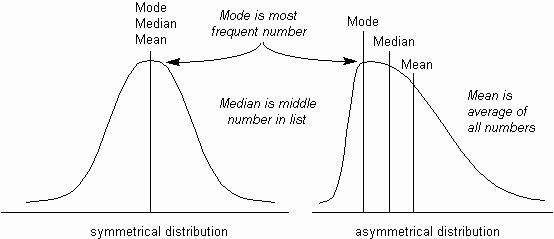
Average or MeanA measure of the center point of a set of numerical data. The average of A, B and C is (A+B+C)/3. 'Average' is the common parlance word; in Mathematical circles, the word 'Mean' is used, although they have identical meaning (oh, the wit).The advantage of the average is that it takes all numbers into account. It can be misleading, however, if there are only a few numbers and one is a significant outlier. For example, the average of 1, 2, 3, 4 and and 297 is 101 (the 297 blows the average way out). With a large set of numbers, one or two outliers will tend to have less effect on the overall average (or mean, of course). Whilst Average gives a measure of central tendency, the common method of measuring the spread of a set of numbers is the Standard Deviation. Other methods of measuring central tendency are Mean (or Average) and Mode.
See also:Median, Mode, Standard DistributionToolbook chapter: Variation |
Site Menu |
|
Quality: | Quality Toolbook | Tools of the Trade | Improvement Encyclopedia | Quality Articles | Being Creative | Being Persuasive | |
|
And: | C Style (Book) | Stories | Articles | Bookstore | My Photos | About | Contact | |
|
Settings: | Computer layout | Mobile layout | Small font | Medium font | Large font | Translate | |
You can buy books here |
|
And the big |