The Psychology of Quality and More
|
|
The Psychology of Quality and More |
|
A Toolbook for Quality Improvement and Problem Solving (contents) |
Measuring spreadThe Quality Toolbook > Variation > Measuring spread
There are two main ways of measuring the degree of spread of a set of measurements: the range and the standard deviation.
RangeThe range of a set of measures is simply the difference between the largest and the smallest measurement value. Thus, for example, if you have a set of measures (21, 22, 26, 19, 12, 24, 33) then you first find the highest measure (33) and subtract the lowest measure (12) to give the range (21). This is easy to calculate, but there can be several problems with using it:
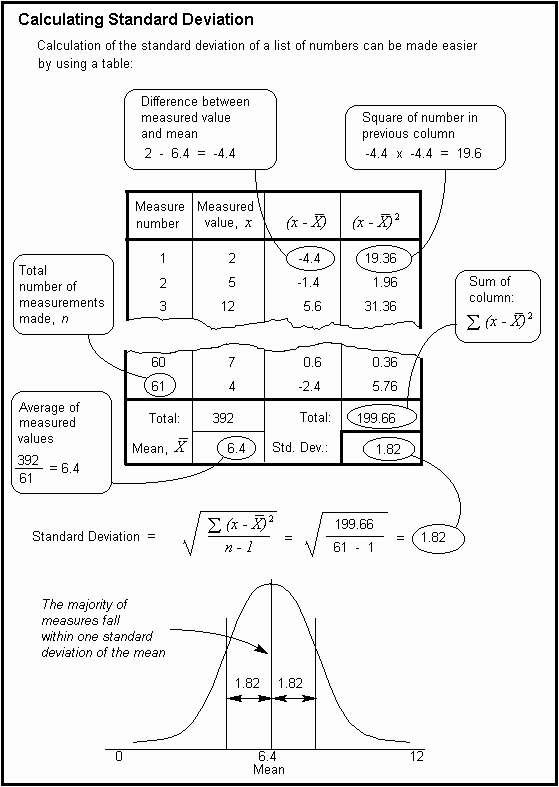
Standard deviationThe standard deviation is a number which is calculated using a simple mathematical trick (calculating the square root of the average of squares) to find an 'average' number for the distance of the majority of measures from the mean. The standard deviation is of particular value when used with the Normal distribution, where known proportions of the measurements fall within one, two and three standard deviations of the mean, as below.
Fig. 1. Percentages in Normal Distribution between Standard Deviations
Thus, given a set of measures, the mean and the standard deviation can be calculated, and from this can be derived the probability of future measures falling into the three bands, provided that the distribution is normal (a simple visual test for this is to draw a histogram and look for the bell shape). For example, if the gunner has an average score of 56 per target card, with a standard deviation of 6, then, provided the distribution is normal:
or, breaking out the six bands:
|
Site Menu |
|
Quality: | Quality Toolbook | Tools of the Trade | Improvement Encyclopedia | Quality Articles | Being Creative | Being Persuasive | |
|
And: | C Style (Book) | Stories | Articles | Bookstore | My Photos | About | Contact | |
|
Settings: | Computer layout | Mobile layout | Small font | Medium font | Large font | Translate | |
You can buy books here |
|
And the big |